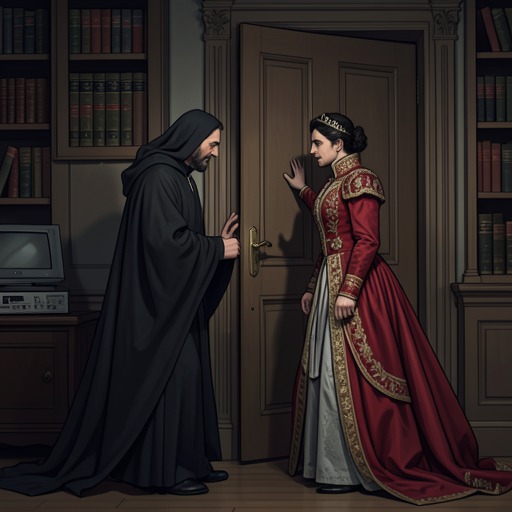
Katherine's Decision to Marry Prince Harry
The King's CurseKatherine of Aragon’s decision to marry Prince Harry turns a private promise into a dynastic and political strategy. Refusing to return to Spain after Arthur Tudor’s death, she argues that marriage to his brother will let her serve England, regain the position of Princess of Wales, and pursue the form of kingship that she and Arthur had planned. The choice also depends on a disputed assertion about her first marriage: that it was never consummated.## Background: A widow who will not leaveMargaret Pole approaches Katherine expecting her to return to Spain, while Margaret herself plans to go home to Stourton. Katherine rejects both expectations. In a quiet conversation away from her ladies, she explains that Arthur had asked her to remain in England and serve the country where she had been born and raised. She regards the promise she made to him on his deathbed as binding, even though he is no longer alive to fulfill their plans with her.Katherine’s proposed way to keep that promise is to marry Prince Harry. The marriage, she reasons, would make her Princess of Wales again and place her in a position to influence England’s future. She does not present the idea as a substitute for Arthur in her affections: Margaret objects that Harry is not the prince they lost, and contrasts his charm and energy with Arthur’s constancy. Katherine accepts that he is different, but believes she can guide him and help him become a better king.## Arthur’s political designIn explaining her decision, Katherine describes a shared political purpose, not merely a personal wish to remain at court. Arthur, she says, intended to rule as a king joined to both the Tudor and York houses. Their imagined government would earn respect through justice and compassion rather than compel obedience. With Arthur’s death, Katherine means to carry that program forward by teaching and guiding his brother.She therefore sees the proposed marriage as a continuation of Arthur’s intentions and as a route to political work. Her confidence that she can shape Harry stands in direct contrast to Margaret’s grief-struck judgment that he can never be Arthur. The disagreement does not change Katherine’s resolve: she believes the younger prince can be made into the kind of ruler England needs.## Dynastic interests and the betrothalThe match also answers needs on the Tudor side. Katherine points out that remarriage would spare the king the cost of her widow’s allowance, transfer the remainder of her dowry to him, and preserve an alliance with Spain. In Margaret’s account, the value of Spanish wealth and power becomes especially pressing because Prince Harry is the Tudors’ scarce male heir. The numerous Plantagenet relatives and marriage alliances that Margaret describes form a striking contrast with a Tudor succession dependent on Harry and the expected child of the royal family.Katherine’s plan is eventually accepted: Margaret hears from her husband that Prince Harry has been betrothed to the Dowager Princess of Wales. The announcement confirms that Katherine’s determination has prevailed, but it is not a wedding. A papal dispensation and a settlement still have to be negotiated, and Margaret’s husband expects that the couple cannot marry for years. The betrothal thus makes the marriage a matter of royal policy while leaving its legal and practical conditions unresolved.## The disputed basis of the marriageKatherine’s claim that she can marry Harry rests on her declaration that her marriage to Arthur was not consummated. She says she will present herself as a virgin and maintain that the marriage was never completed. Margaret doubts that others will believe her, but Katherine argues that people will not dare to challenge a claim made by the princess if her companions do not contradict it. She asks Margaret to stand by her, making silence and loyalty part of the practical means by which the proposed marriage might be enabled.The claim later becomes a source of confrontation. Margaret is pressed to say whether she knows that Arthur and Katherine were lovers, and confirms that Arthur was taken to Katherine’s room once a week under arrangements made in her household. That fact is raised as evidence in the dispute, but the passage does not establish by itself what occurred during those visits. Katherine’s assertion is subsequently denounced as a lie by those who believe the marriage was consummated; the possibility of a papal dispensation is treated as essential to Henry VII’s marrying his son to his brother’s widow. The question of consummation therefore carries consequences beyond the couple’s private history: it bears on whether the new match can be permitted and on who has authority to settle the matter.## SignificanceKatherine’s decision joins personal fidelity to political calculation. Her promise to Arthur supplies the moral reason she gives for staying; her proposed influence over Harry gives that promise a future; and the financial and diplomatic advantages help make the match acceptable to the crown. Yet the plan’s success depends on a contested account of her first marriage and on procedures beyond her control. The betrothal realizes her immediate aim of remaining in England, while the unresolved question of consummation leaves the marriage’s legitimacy open to challenge.